
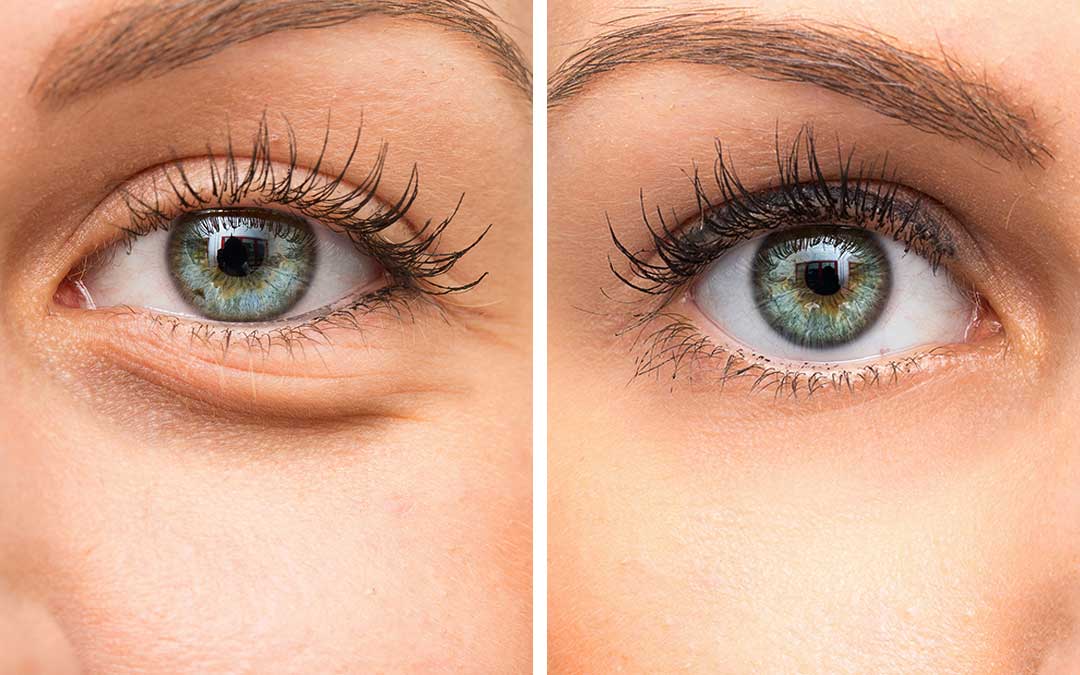
You’re not tired. Your face just looks that way. Here’s why concealer isn’t the answer.
There’s a particular frustration that sets in somewhere in your mid-to-late 30s. You’re sleeping fine. You’re drinking your water. You’ve tried the eye creams — the expensive ones, the ones your friend swore by, the one the dermatologist on Instagram recommends. You’ve perfected your concealer technique. And you still look tired. Still look like something is off under your eyes, like there’s a shadow that won’t lift no matter what you do.
Here’s what nobody is telling you: the problem probably isn’t your skin. It’s what’s underneath it.
The under-eye area is one of the first places on the face where structural volume loss becomes visible, and it creates a look that no topical product is designed to fix, because topical products work on the skin surface. What’s happening under your eyes is happening at a deeper level entirely.
What’s Actually Going On Under There
The area between the lower eyelid and the upper cheek is called the tear trough. In youth, this area is naturally full — the fat pad that sits beneath the eye is robust, the cheek fat pad below it sits high and forward, and the transition from under-eye to cheek is smooth and seamless.
As we age, several things happen simultaneously and none of them are kind to this particular area:
The fat pad beneath the eye loses volume and begins to shift. The cheek fat pad below it descends. The skin thins as collagen production slows. The ligament that runs along the orbital bone becomes more prominent as the tissue above and below it deflates.
The result is a hollow, a shadowed trough that runs from the inner corner of the eye outward, sometimes curving down toward the cheek. That hollow casts a shadow. That shadow reads as darkness. And that darkness is what you’ve been trying to cover with concealer, which is a bit like trying to fill a pothole with paint. The surface looks different but the structure underneath is unchanged.
Why Concealer Makes It Worse
This is the part that surprises a lot of people. Concealer applied to a hollow doesn’t just fail to fix it — in many cases it actually emphasizes it.
The reason is simple: concealer sits on the surface of the skin and settles into texture and creases. In a flat, even area it looks fine. Applied over a hollow, it catches in the deepest part of the depression and creates a lighter patch that draws the eye directly to the thing you’re trying to hide. Layer enough product to mask the shadow and you end up with a thick, cakey under-eye that still looks dark in the right light and now also looks heavy.
The cosmetics industry has built an entire category of product around this problem: illuminating concealers, color-correcting peach tones, setting powders, brightening eye creams. While all of them work within the limits of what they are, they are surface-level solutions to a structural problem.
The Dark Circle Myth: Pigment vs. Structure
Not all dark circles are the same, and this distinction matters when it comes to treatment.
| Type | Primary Cause | Effective Treatments |
|---|---|---|
| Pigmentary | Hyperpigmentation in the skin itself, often hereditary or driven by sun exposure | Topical brighteners, chemical peels, BBL/IPL |
| Structural | Shadows cast by volume loss, often combined with blood vessels visible through thinning skin | Dermal fillers to restore volume and eliminate the hollow |
The majority of under-eye darkness in women over 35 is structural. Neither shadows nor visible blood vessels respond meaningfully to brightening ingredients or concealer. They require a structural solution.
What Actually Fixes It
Tear trough filler is one of the most transformative treatments available at a med spa, and also one of the most underutilized, largely because people don’t know it exists or assume it’s only for dramatic cosmetic changes rather than the subtle, restorative correction it actually produces when done well.
The treatment uses a soft hyaluronic acid filler, specifically Juvéderm Volbella XC or Restylane Eyelight, both explicitly FDA-approved for the delicate under-eye area, which is injected into the tear trough to restore the volume that has been lost. When placed correctly, the filler fills the hollow, eliminates the shadow, and creates a smooth, seamless transition from under-eye to cheek. The darkness lifts not because the pigment changed but because the hollow casting the shadow no longer exists.
Results can be subtle enough that people can’t identify what changed, only that you look more rested, more vibrant, more like yourself. That’s the goal. Not a different face. Just yours, without the shadow.
The procedure requires real skill and anatomical knowledge. The tear trough is a delicate area with a specific vascular architecture, and injector experience is not optional here. It’s one of the areas where the difference between an excellent injector and a mediocre one is most visible, and most consequential.
What to Expect
Tear trough filler is typically a quick procedure, often completed in under thirty minutes, with minimal downtime. Some bruising and swelling are common in the first few days given the delicacy of the tissue and the proximity to the eye. Most people see their true result at one to two weeks once any swelling has resolved.
Results last anywhere from nine months to well over a year depending on the individual and the product used. Because the area is relatively immobile compared to areas like the lips, filler in the tear trough tends to be among the longer-lasting applications.
The Mid-Face Connection
It’s worth noting that tear trough filler is not always the only answer, or even the first one. In some cases, restoring volume to the cheeks with Juvéderm Voluma XC is the more effective starting point, because lifting the mid-face reduces the appearance of hollowing under the eye by restoring the structural support below it. An experienced injector will assess the whole picture rather than just treating the area you’ve pointed to.
The Conversation Worth Having
If you’ve been blaming yourself for not finding the right concealer, or assuming the under-eye darkness is just something you have to live with, the conversation worth having is with an injector rather than a makeup artist. Not because filler is the right answer for everyone, but because knowing what’s actually causing what you’re seeing in the mirror is the beginning of actually being able to do something about it. A consultation is the place to find out whether you’re dealing with volume loss, pigmentation, vascular visibility, or some combination, and what the realistic options are for each.
We see this particular concern more than almost any other. And we genuinely love treating it, because the results are some of the most meaningful we produce. When someone who has looked tired for years sees their face without that shadow for the first time, the response is pretty consistent.
It’s not “I look different.” It’s “I look like me again.”
Spa Bella Medispa is Denver’s leading medical spa, located at 1685 S Colorado Blvd, Suite C. Call or text us at (303) 512-9000 or book online.