
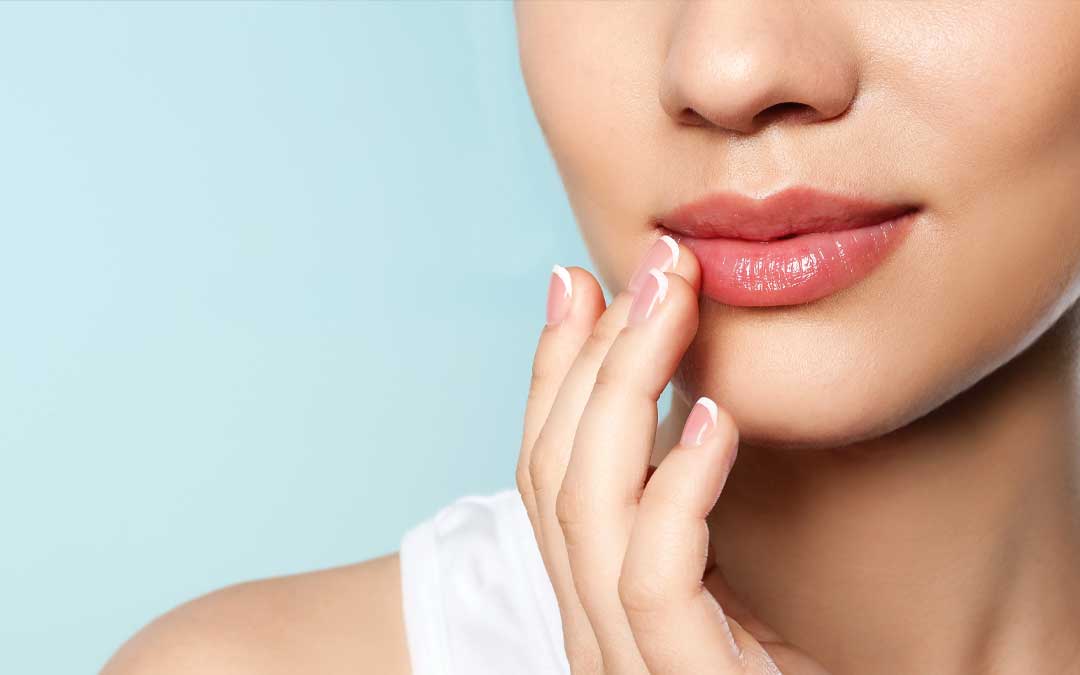
There’s a moment most women notice it. Maybe it’s a photo where your lips look thinner than you remember them being. Maybe it’s that your lipstick bleeds a little now in a way it never used to. Maybe you just look in the mirror one day and something about the middle third of your face seems… flatter.
You’re not imagining it. Lip volume loss is real, it’s progressive, and it starts earlier than most people realize. The good news is that understanding what’s happening and when makes it a lot easier to do something about it before it becomes the thing you’re trying to correct rather than prevent.
Here’s what the timeline actually looks like.
Your 20s: The Baseline You’ll Spend the Rest of Your Life Comparing Yourself To
In your 20s, your lips are at or near their natural peak. Collagen production is high, hyaluronic acid levels in the tissue are robust, and the fat pads that give your face its structure are exactly where they’re supposed to be. The vermillion border, the defined edge that separates your lips from the surrounding skin, is sharp. The cupid’s bow has definition. The lips themselves have a natural projection and fullness that requires zero effort to maintain.
This is worth noting not to be depressing, but because it explains why the changes that come later feel so gradual and then suddenly so obvious. You’re losing ground slowly against a very good baseline.
Collagen production starts declining in your mid-to-late 20s at roughly 1% per year. You won’t see it yet. But the process has already begun.
Your 30s: The Subtle Shift
This is the decade when most women first notice something, even if they can’t quite articulate what it is. The lips themselves may not look dramatically different, but the surrounding architecture starts to change.
The vermillion border loses a little of its crispness. The philtrum, the two vertical lines that run from your nose to your upper lip, begins to flatten slightly. The upper lip in particular starts to thin. It loses a little of its projection, a little of its curl. Lipstick that used to sit neatly on the lip line starts to require more precision.
The other thing that happens in your 30s is that the fat pads in the cheeks and mid-face begin a slow downward migration. This affects the lips indirectly but meaningfully: as support structures above and around the mouth shift, the lip area loses some of its scaffolding. The mouth can start to look slightly longer vertically, which contributes to a subtle flattening of the overall lip shape.
Most women in their 30s aren’t thinking about lip filler. But this is actually the ideal time to have a conversation about it, not because anything is wrong, but because small, early interventions produce the most natural results and require the least product to maintain.
Your 40s: When It Becomes Hard to Ignore
The changes that were subtle in your 30s become more apparent in your 40s, and they compound. Collagen loss accelerates. The lips thin more noticeably, particularly the upper lip. The vermillion border continues to soften, and fine lines, sometimes called lipstick lines or perioral lines, begin to appear above the upper lip. These are caused by the same repeated muscle movement (talking, smiling, drinking through straws) that creates expression lines elsewhere on the face, but without the collagen infrastructure to bounce back the way it used to.
The corners of the mouth can begin to turn downward slightly, which is one of the subtle changes that makes a face read as tired or stern even when the person feels neither. Volume loss in the body of the lip itself becomes noticeable, particularly when comparing photos from a decade earlier.
This is also the decade when many women first seek treatment, often because they’ve reached a threshold where the change is visible enough to bother them. The results at this stage are still excellent, but more product is typically needed to restore what’s been lost versus what would have been needed to simply maintain it starting in the 30s.
Your 50s and Beyond: The Cumulative Picture
By the 50s, the combination of factors that have been building for decades become collectively significant. Lip volume can be dramatically reduced from its peak. The vermillion border may be largely absent without lip liner. Perioral lines deepen. The corners of the mouth may sit notably lower. The overall lip area can look drawn in, with less distinction between the lips and the surrounding skin.
Hormonal changes around and after menopause accelerate collagen loss significantly, often producing a noticeable jump in the rate of change that women in their early 50s frequently describe as feeling sudden, even though the process has been gradual for decades.
Treatment at this stage is absolutely effective, but the goal shifts from maintenance to restoration, and the approach typically involves not just lip filler but a broader look at the surrounding structures, including the corners of the mouth, the perioral lines, and the overall mid-face support.
What Actually Helps
The treatment most directly suited to lip volume loss is Juvéderm Volbella, a hyaluronic acid filler specifically formulated for the lips and the delicate perioral area. It’s softer and more subtle than traditional fillers, which is why it produces results that look like your lips on a better day rather than lips that have obviously been filled. It adds volume, restores definition to the vermillion border, and smooths the fine lines above the lip without creating the stiffness or obvious augmentation that gave lip filler a bad reputation in the early days.
Hyaluronic acid fillers are also reversible, which matters to a lot of people who are considering treatment for the first time. If you don’t love the result, it can be dissolved. That safety net makes it a much lower-stakes decision than most people initially assume.
Results typically last six to twelve months depending on the individual, the amount of product used, and how quickly your body metabolizes it.
The Honest Bottom Line
You have more control over this than the beauty industry typically lets on. Lip volume loss is not an inevitable cliff you fall off at some point in your 40s. It’s a gradual process that responds well to early, conservative treatment. The women whose lips look naturally full in their 40s and 50s are almost certainly not genetically lucky. They’re maintaining something, quietly, over time.
The best time to start a conversation about it is before you feel like you urgently need to. Come in, let us look at where you are, and we’ll tell you honestly what we see and what, if anything, makes sense for you right now.
That conversation is always free.
Spa Bella Medispa is Denver’s leading medical spa, located at 1685 S Colorado Blvd, Suite C. Call us at (303) 512-9000 or book online.